Marketplace Store Design

Brand stores, enhanced content and category pages designed inside each marketplace own template rules.

Brand store built properly

Enhanced content that sells

Inside platform rules

Mobile checked first

What Marketplace Store Design covers
Included In Every Store

A Storefront That Looks Like

Your Brand
A marketplace storefront is the one place you control how your brand looks on somebody else platform. We design it inside their template rules, so it passes review the first time and reads properly on a phone.
What is included when we deliver Marketplace Store Design
Brand store built properly
Modules used well
Passes review first time
Mobile checked first

Home, category and product pages laid out in the marketplace own builder, with navigation a shopper can use rather than the single-page default most brands stop at.

Marketplaces

Comparison tables, feature modules and lifestyle imagery arranged so the questions that stop a purchase get answered early, using the module types the platform actually offers.

Get a quote

Every marketplace has rules on claims, contact details, pricing references and image content. We design to them, because a rejected store costs you a fortnight.

Marketplaces

Marketplace traffic skews heavily to the app, and the builders preview desktop by default. We check the phone layout before submitting rather than after.

Get a quote

Type, colour and photography follow your own site, so a shopper who found you on a marketplace and then visits your store recognises the same company.

Marketplaces

We compare conversion and session depth before and after, because a storefront redesign that looks better and converts the same is not finished.

Get a quote

Our Proven Process

A Proven Process for Every Project

From the first conversation to long-term support, you always know which stage the work is in and what happens next.
  • Discover

    We start with your goals, your buyers and what the current site costs you.

  • Plan

    You get a scope, a sitemap and a timeline before anything is designed.

  • Design

    Layouts are drawn around your services and reviewed with you, page by page.

  • Develop

    We build it clean and fast, with the CMS set up for your team to run.

  • Test

    Forms, speed, security and every breakpoint are checked before launch.

  • Launch

    We migrate, redirect and go live, then watch the first week closely.

  • Support

    Updates, backups and monitoring continue, with a person you can reach.

Book a consultation

Ready to Start Your Project?

Let’s build something great together.
Our Technology Stack

Built on the Channels Your Buyers Use

Every marketplace has its own rules for listings, fees and fulfilment, and ignoring them is what quietly caps sales. We work natively in Amazon, eBay, Etsy and Walmart, run your own store on Shopify or WooCommerce, and take payments through Stripe and PayPal — with a single inventory feeding all of them.
Why Choose Us

Why Brands Choose Our Ecommerce Team

Marketplace selling punishes small operational mistakes. These four are where we earn our fee.
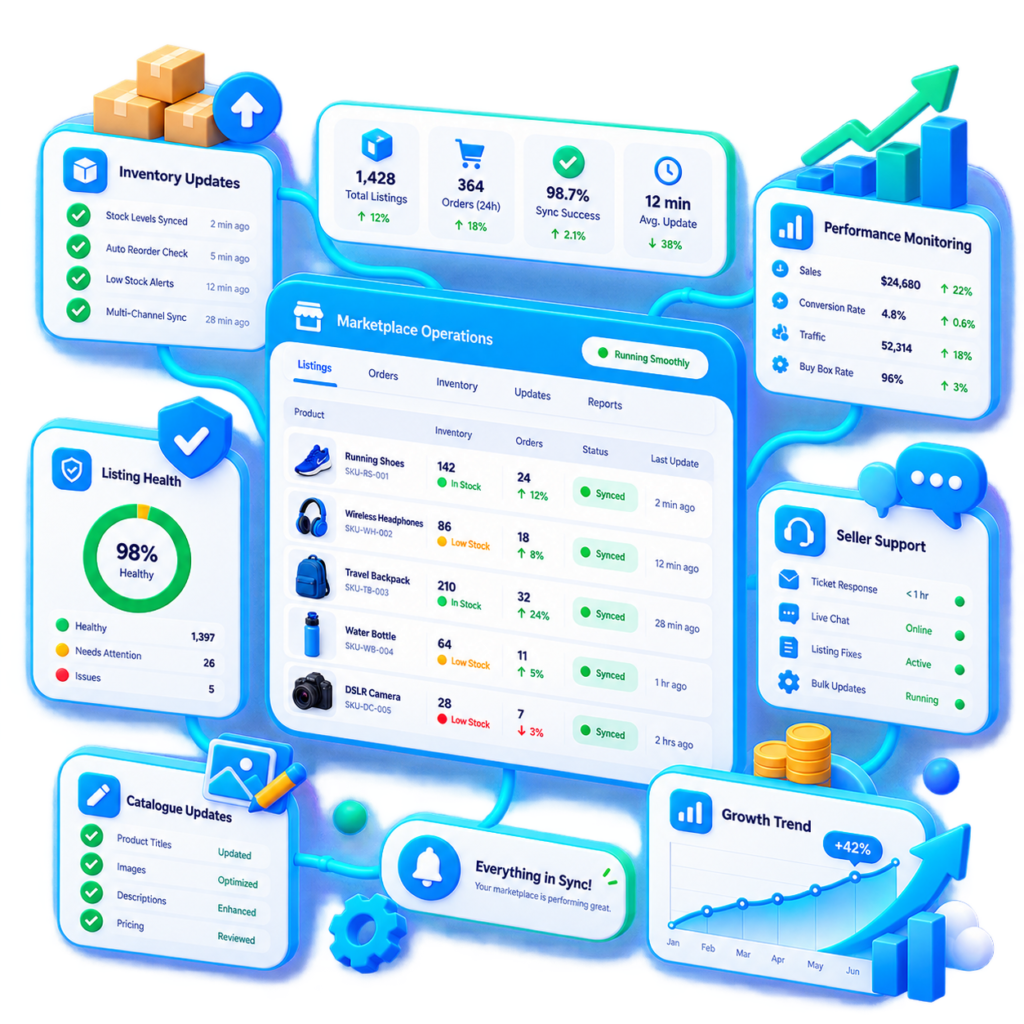
Sales rising across multiple channels with stock kept in sync

Real Marketplace Experience

Marketplaces are not websites with a different skin. Each has its own ranking signals, fee structure, fulfilment options and enforcement behaviour, and a suspended account costs more than a slow month. We work inside those rules daily, so you are not learning them through penalties.

Listings Built to Rank

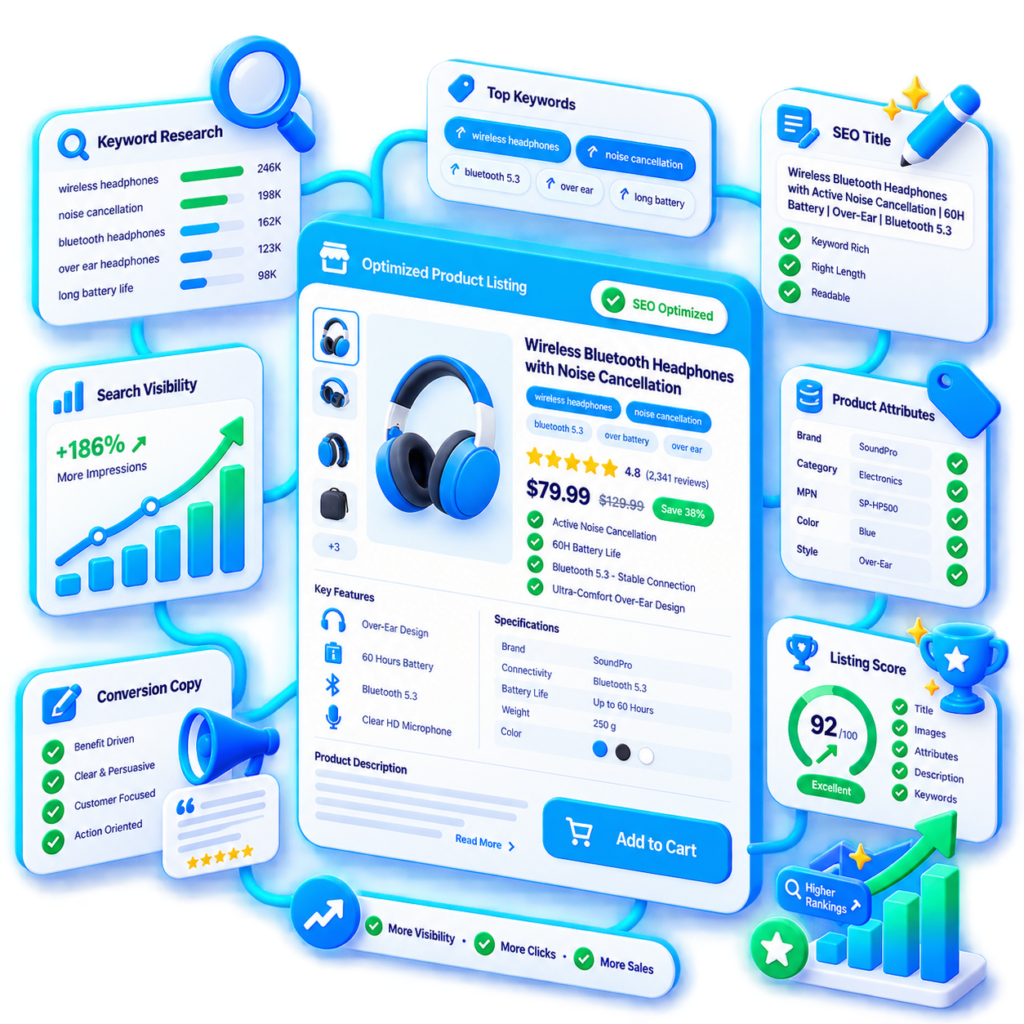
Marketplace search rewards different things than Google: title structure, complete attributes, backend keywords, image count, review velocity and stock health. We fix those in the order that moves position fastest, and track rank per keyword so you can see which change did the work.

Growth You Can Measure

You get one monthly report covering the numbers that decide profitability — units, average order value, ad cost as a share of revenue, return rate and account health. If a channel is not paying for itself we recommend pausing it, because volume on the wrong channel is not growth.

One Stock, Every Channel

Overselling is the fastest way to lose an account, and it happens whenever four channels each believe they own the same unit. We make one system the source of truth and sync the rest to it, so a sale anywhere adjusts the same number and orders arrive in one queue.

CLIENT TESTIMONIALS

Trusted by Businesses. Proven by Results.

Our clients’ success stories speak louder than words. Discover how we’ve helped businesses transform their digital presence with custom websites, software solutions, AI-powered applications, and ongoing support that delivers real results.

Google Review
Common Questions

Have questions? We've got answers

Which marketplaces should we sell on first?

Start with one, and choose it on category fit and margin rather than raw traffic. Amazon has the largest audience and the strictest operational demands; Etsy suits handmade and personalised goods; eBay still performs strongly for parts, refurbished and hard-to-find items; Walmart is less crowded and easier to rank in early. We look at your margins after fees and shipping before recommending anything, because a channel that cannot carry your cost base is not an opportunity.


How long does it take to get approved and launched?

Account registration and verification typically take one to three weeks depending on the platform and how quickly business documents come together. Category approval for restricted products can add longer. Once the account is live, a straightforward catalogue can be listed and selling within a fortnight. We supervise the first weeks closely, because early metrics — late shipment rate, defect rate — set your account standing and are much cheaper to protect than to repair.

How do you stop us overselling across channels?

By making one system the single source of truth for stock and syncing everything else to it, so a sale on any channel adjusts the same number. Which system takes that role depends on how you already work — sometimes the POS, sometimes the ecommerce platform, sometimes an ERP. We also hold a small buffer on fast-moving lines, because no sync is instant and an oversell costs account health, not just a refund.

Do you handle marketplace advertising as well as listings?

Yes, though we usually fix the listing first. Advertising a poorly optimised product page raises your cost per sale and hides the real problem — paid traffic converts on the same content organic traffic does. Once titles, images, attributes and reviews are in order, we run sponsored campaigns with a target advertising cost of sale you agree in advance, and report on ad spend as a share of revenue rather than clicks.

What happens if our marketplace account is suspended?

We treat it as an emergency, because reinstatement gets harder the longer it runs. First we identify the specific policy cited rather than guessing, then prepare a plan of action addressing root cause and preventative steps in the format the platform expects. Most suspensions trace back to a measurable metric — late shipments, inauthentic claims, safety complaints — which is exactly why we monitor account health continuously rather than reacting to it.

Do we still need our own website if we sell on marketplaces?

Yes, and the reason is commercial rather than sentimental. On a marketplace you rent the customer relationship: you do not own the buyer’s contact details, you compete on the same page as substitutes, and a policy change can alter your economics overnight. Your own store carries better margins, lets you build an email list and retarget, and gives buyers who search your brand name somewhere credible to land.

Can you migrate our existing listings?

Yes. We export what you have, map it to the destination platform’s category and attribute structure, and clean it on the way through rather than replicating old problems — missing attributes, thin titles and low-resolution images are the usual finds. Reviews generally cannot transfer between platforms, so we plan for building review velocity on the new channel from launch instead of leaving it to chance.

How do marketplace fees affect our margins?

Substantially, and they are easy to underestimate because they stack: a referral fee, fulfilment or shipping cost, storage, returns processing, and advertising all come off the same sale. We model your true contribution per unit after all of it before recommending a channel or a price. Some products are simply not viable on some marketplaces, and knowing which ones early is more valuable than launching everything and finding out.

Our Recent Work
Start Your Project

Ready to Move Forward with Marketplace Store Design?

Tell us what you need and we will scope it, price it, and say honestly whether we are the right team for the job.
  • Free

    Consultation

  • Transparent

    Pricing

  • No Obligation

    Quote

  • Quick

    Turnaround

Prefer to connect instantly?

Book a free 15 to 30 minute consultation with our team.
WhatsApp
Quick answers to a quick question, without the back and forth.
+1 (647) 495-9114, Mon to Fri, 9AM to 6PM EST.

Get a quote for Marketplace Store Design

Tell us what you are trying to do and we will come back with a plan and a price. No cost, and no obligation to go ahead.
  • Tailored Solutions for Your Goals
  • Experienced and Trusted Team
  • On-Time Delivery, Every Time
  • 100% Confidential and Secure